






What Is the Best Time for a Safari in Kenya?
(Here’s What Our Safari Experts Recommend):

Key Takeaways
– There is no single best month to visit Kenya. The right time depends on what you want from your safari, whether that is migration sightings, newborn wildlife, dramatic green-season landscapes for photography, birdlife fewer crowds or better value.
– The dry seasons are often the easiest for first-time safari travellers. Shorter grass, fewer water sources and concentrated wildlife can make animals easier to find and track.
– February and March offer some of the most rewarding wildlife experiences. Calving season brings thousands of newborn animals and increased predator activity, creating unforgettable moments in the bush.
– The green season is one of the most rewarding times to visit. Expect lush landscapes, moody skies, wonderful light, newborn wildlife, fewer vehicles and much lower prices.
– June and October offer an excellent balance of wildlife, value and fewer crowds. These shoulder months allow you to enjoy many benefits of peak season while avoiding the busiest periods.
– Seasons are less predictable than they used to be. Rains now start earlier, later or unevenly, so we plan around flexibility rather than fixed dates.
– Where you stay matters as much as when you travel. Private conservancies (such as our Porini Camps) allow you to avoid crowds, enjoy greater flexibility and experience Kenya’s wilderness more exclusively.
– The best safari is the one designed around your priorities. By choosing your season based on the experience you want, you can travel with confidence knowing you have selected the right time for your dream Kenya safari.
Table of Contents
What is the best time to visit Kenya for a safari?
The quick answer is that there is no single date on the calendar that works for everyone. Indeed, every month of the year has something magical to behold.
Instead, the right time to visit depends entirely on what you want from your safari experience.
Are you hoping to:
– Witness the Great Migration in the Masai Mara?
– Capture Kenya’s most spectacular landscapes and wildlife through your camera lens?
– See newborn animals during calving season and experience the predator activity that follows?
– Combine your safari with relaxing days on Kenya’s beautiful coastline?
– Travel outside peak season for better value?
– Escape the crowds and enjoy a more private wilderness experience?
In this guide, I’ll explain what each season offers so you can understand the main benefits and the trade-offs and choose the time of year that best matches your ideal Kenya safari.
So let’s get started.
When is the best season to visit Kenya for a safari?
For most first-time visitors, July to October (Great Migration, dry conditions) and January to March (hot, dry, lots of young animals) are the easiest times to see lots of wildlife. But every season has something special, and some of our most memorable safaris happen in the green season.
Here’s what you can expect from each season:
| Season | Months | Best for | Conditions | Price Level ($-$$$) |
|---|---|---|---|---|
|
Dry Season |
Jan-Feb |
Newborns, predator action, clear diving waters. |
Hot , dry, some dust |
$$ |
|
Green season (long rains) |
Mar–May |
Lush landscapes, photography, solitude. |
Wet and unpredictable, some camps closed |
$ |
|
Green season (post rains) |
June |
Newborn animals, green & lush scenery |
Rain easing, warm days, long grass |
$ |
|
Great Migration |
Jul–Oct |
Mara River crossings, easy game viewing |
Dry, mild |
$$$ |
|
Green season (short rains) |
Nov–Dec |
Birdwatching, newborn animals, fresh landscapes |
Short, intermittent rain |
$$ |
My favourite time to visit Kenya is February.
Here’s why:
Personally, I really love February and March. There are lots of young animals being born, and that brings fantastic opportunities to see predator activity as well. It is just a really special time to be out in the bush because you are seeing that cycle of life happening all around you.
February can still be hot and dry, though the chances are there will be a few more days of rain as the rainy season tends to begin in mid-March.
When is the best time to go to Kenya to see the Great Migration?
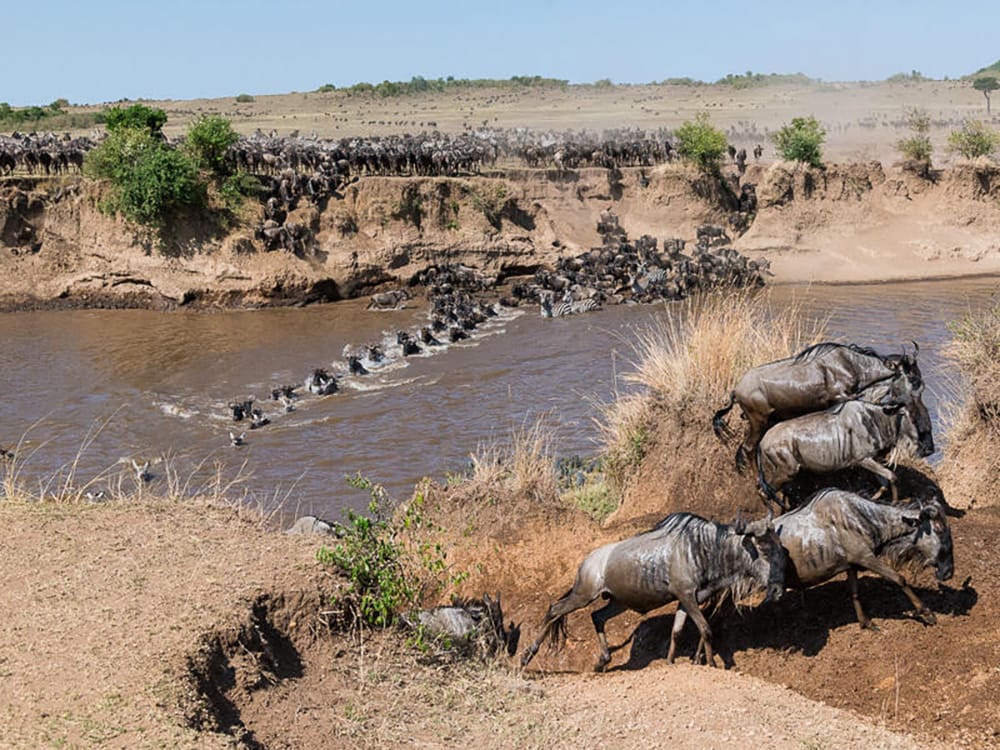
This season needs no introduction. It is the time when millions of wildebeest and zebras pour across the plains of Kenya.
Between July and September, with August and September marking the absolute peak. Here you are most likely to witness the famed and dramatic Mara River crossings (although the exact timing of these events can never be guaranteed).
The Great Migration is one of Kenya’s and the world’s greatest wildlife spectacles.
Want to experience peak season without the crowds?
If you want to be in the thick of the action but don’t want to deal with crowds, then our Porini Camps are the ideal solution. They are situated very close to where the action is. Our camps are located on conservancies with strict guest and vehicle limitations, so even in peak season you will feel relatively secluded.
The green season: Kenya's best-kept secret

The rains breathe new life into the plains. The dusty golden landscapes begin to change, fresh vegetation appears, and Kenya takes on a completely different character. There are fewer visitors, and photographers can capture some of the most dramatic scenery of the year. The combination of dark skies, formidable rain clouds hovering over fresh landscapes, and beautiful light are all ingredients for unforgettable images. For me, this is one of the most beautiful transitions of the year because you see the landscape begin to regenerate.
What you’ll love about the green season:
– Landscapes and photography: Towering storm clouds over fresh green grass, rainbows across the plains and that late-afternoon “spotlight” light, which photographers love.
– Newborn wildlife and predator action: Many animals give birth after the rains, and predators follow.
– Quiet: Far fewer visitors, even in the most famous areas.
– Value: Prices are the lowest of the year with plenty of special offers to be found. Now is the time to secure a great deal on your Kenya safari.
– Birdlife: Kenya hosts over 1,100 bird species, resident birds are in breeding plumage and November also marks the arrival of migratory species, such as the European bee-eater and the Steppe eagle.
Seasons are changing and Kenya’s rainy seasons are no longer as consistent or predictable as they used to be. The long rains may start early, late or in fits and starts, and the “dry” months can bring surprise showers. So we never promise specific weather. Think of the seasons as tendencies rather than guarantees, and choose your dates with that in mind
Calving season: when the plains come alive

Most safari-goer asks about “calving season”, but there is no single calving season across Kenya. Different species reproduce at different times, influenced by rainfall, food availability and local conditions.
Wildebeest are the most dramatic example. In the Masai Mara ecosystem, they generally calve from January to March, with February often the peak. The Mara’s community conservancies, including Ol Kinyei Conservancy, can offer excellent opportunities to see newborn wildebeest and the predators that follow them.
Other herbivores have different breeding cycles. Antelope, zebra, giraffe and other species give birth at various times of year, often when conditions provide good food for mothers and young. Following the rains, fresh grass and new growth can mean more young animals are visible, but there is no single period that applies across all species or regions.
Where there are vulnerable young animals, predators are never far away. Lions, cheetahs, leopards and other predators may take advantage of the opportunity, making periods when young are plentiful particularly rewarding for predator sightings.
What to expect:
Expect newborns, active predators and excellent opportunities for close-up wildlife observation. Wildlife species give birth at different times of year, so young wildlife can be seen throughout the seasons, with peak wildebeest calving in the Mara Conservancies from January to March.
Beyond the bush: Kenya’s coastal season
Many of our guests combine safari with a few days on the Kenyan coast, and timing here matters too.
– Whale sharks: Typically seen from around November to March, with sightings often peaking in January and February along the Watamu/Malindi Coast and the South Coast of Diani. These are wild animals so sightings are never guaranteed, but few visitors know they are an option.
– Scuba diving and snorkelling: November–March for the calmest seas and clearest underwater visibility, with January–February particularly good.
– Turtles: Green and other sea turtles nest along the Kenyan coast, with hatchlings emerging from around January to May, depending on when the eggs were laid. Watching hatchlings reach the sea is one of the coast’s most moving wildlife experiences.
– Humpback whales: Often seen off the coast between roughly July and October.
– Beach weather: Kenya’s coast is warm year-round. January to February are typically among the hottest and driest months, while June to October is generally cooler, drier and often sunny. March to May brings the long rains, while October to December brings the shorter rains, although sunny periods are still common.
Month-by-month highlights
January to February: Wildebeest calving, clear skies and the coast
| Pros | Cons |
|---|---|
| January to February: Calving season, newborn wildlife and clear skies | No Great Migration |
| Dramatic predator action | Peak daytime heat (temperatures can soar in February) |
| Fewer crowds & lower rates | Some safari areas can have dry and dusty conditions |
March to May: The green season
The wettest months, and the greenest and quietest. Expect dramatic skies, less visitors and the best prices.
The landscapes are lush and green, there are fewer visitors, and photographers can capture some of the most dramatic scenery of the year. The combination of dark skies, formidable rain clouds hovering over fresh landscapes, and beautiful light are all ingredients for unforgettable images.
For travellers who value solitude, photography or a quieter experience, the green season can be a surprisingly rewarding time to visit.
| Pros | Cons |
|---|---|
| Prices are at their absolute lowest | Tricky wildlife tracking |
| You’ll feel like Kenya is yours alone | Potential for challenging road & travel conditions |
| Dramatic, atmospheric landscapes | Rain can make some areas muddy and less accessible |
June: A quieter safari with excellent value
June is one of the periods I think is really worth considering because you can enjoy a fantastic safari experience before peak migration crowds arrive.
June sits in an interesting window. The rains have eased, the landscape is still looking green, and you are travelling before the busiest months of July, August and September. Yet you can still have incredible wildlife encounters, but with fewer visitors and often much better value.
The difference in cost can be significant. A six-night Porini safari in June is around $4,965 per person, compared with $7,030 per person during peak season. Travelling just a week earlier can save close to $2,000 per person.

| Pros | Cons |
|---|---|
| Excellent value before peak migration prices arrive | Wildlife tracking can sometimes be more challenging, as longer grass and thicker vegetation can make animals harder to spot. |
| The landscape is incredibly lush and vibrant, with some of Kenya’s most atmospheric scenery in my opinion | Expect some rainy days; some routes may be inaccessible if there’s too much rain |
July to October: The Great Migration and peak safari season
| Pros | Cons |
|---|---|
| The ultimate wildlife spectacle | Expect crowds and vehicle congestion in the national parks |
| Optimal viewing conditions with mild, comfortable temperatures and almost no rainfall | The most expensive time to visit |
| You can enjoy all the benefits the peak season has to offer without the crowds at our Porini Camps | Bookings need to be made well in advance as camps and lodges can get booked up well ahead of time during peak season |
November to December: The second green season
| Pros | Cons |
|---|---|
| Prime time for birdwatching | Weather can be humid and sticky |
| Short rains don’t interfere with safaris much, and give a very crisp air | Lots of insect activity |
| Excellent value for money with prices lower than previous months - Tip check for any offers available at this time | Expect some rainy days; some routes may be inaccessible if there’s too much rain |
When is the best time for your Kenya safari based on what you want out of the trip?
The best time for crowd-avoiders
June and October are the best shoulder months as they offer fantastic game viewing — indeed some of the best activities of the peak season — and yet there are much fewer crowds.
The best time for value for money
The green seasons (Mar-May & Nov-Dec) often offer the best value for money. For travellers who are flexible with dates, the green seasons can combine a more affordable safari with beautiful scenery and rewarding wildlife viewing.
The best time for photographers
I would say March to May and November to December. Both windows offer massive, bruised-purple storm clouds that build over the open savanna, creating intense contrast against golden grass or animals lit by stray beams of sunlight.
Also, when the sun breaks through heavy afternoon rain clouds just before setting, it creates a ‘spotlight’ effect — a warm, intense golden light that cuts through a dark, moody background. Rainbows across the plains are also very common during these months.
February is also a great opportunity to photograph newborns and fast-paced predator hunts and of course Migration season for those epic river crossings and predator shots.
The best time for honeymooners and beach-combo travellers
January to mid-March are the hottest months and a great time to hit the beach in Kenya!
For couples seeking snorkelling or scuba diving extensions in Diani or Watamu, water visibility is at its clearest during January and February.
The best time for birdwatchers
November to April is particularly rewarding for birdwatchers, when many Palearctic migrants have arrived in Kenya from Europe and Asia to spend the northern winter. They join Kenya’s resident species and African migrants, increasing both the variety and number of birds you can see. Wetlands, lakes, grasslands and coastal habitats can be especially productive, with species ranging from migrant waders and raptors to colourful resident birds. March to April can be particularly good in some areas, as migrants are still present and the rains bring fresh vegetation and increased insect activity.
Here is the best way to visit Kenya for a safari, no matter what time of year it is
We have seven Porini Camps and our Porini Safari Cottages, that we run on private conservancies all over Kenya. At each camp, only:
– one tent per 700 acres
– and one tourist vehicle per 1,400 acres is permitted
Our Porini Camps are located in private conservancies alongside some of Kenya’s most famous parks and reserves. This means you can enjoy incredible wildlife viewing away from the busiest areas, while still having the option to visit the national parks when you wish.
In a private conservancy, you are not restricted in the same way as you would be in a national park, meaning you can enjoy experiences such as:
– night game drives, searching for nocturnal wildlife such as leopards, lions and hyenas
– off-road tracking to get closer to wildlife spending as much time as you wish at special sightings.
This flexibility is invaluable at all times of the year. Even if you’re visiting during the long rains, being based in a private conservancy allows your guides to adapt. If one route is affected, they can explore another area, follow different wildlife movements and make sure you still have the best possible experience.
You’ll experience Kenya on nature’s terms, with truly expert local guides who understand the landscape around them and even know the animals by name, while supporting responsible tourism that benefits local communities and conservation efforts.
Check out our Porini Camps here and check out the rewards and recognition our camps and safaris have earned over our 35+ years in operation.
Conclusion
The best time to visit Kenya isn’t a date on the calendar; it’s the season that matches the safari experience you dream of.
Every season brings its own rewards, from peak wildlife encounters and migration spectacles to quieter camps, lower prices and breathtaking landscapes. And I believe, with the flexibility of our private conservancy Camps, you can experience Kenya at its very best, whatever month you choose to visit.
Ready to choose your Kenya safari dates?

Author: Robyn Beattie
Born in Kenya and raised in the UK, Robyn has spent much of her life returning to Kenya and travelling extensively throughout the country and across Africa. With more than 15 years’ experience in the safari industry, she has extensive knowledge of Kenya and first-hand experience of every Porini Camp, complemented by extensive travel throughout Africa.
You can contact Robyn on her work email at: robyn@gamewatchers.com