Ol Kinyei Conservancy: A Wildlife Paradise in Masai Mara

Lions on the Ol Kinyei Conservancy

Conservation

Lions on the Ol Kinyei Conservancy

Ol Kinyei Conservancy: A Wildlife Paradise in Masai Mara

In our latest video, “Exploring the Rich History of Ol Kinyei”, you can discover the history of Ol Kinyei Conservancy, one of the pioneer conservancies in Kenya’s Masai Mara.

Established in 2005, Ol Kinyei has been a trailblazer in conservation efforts, making it the only IUCN Green List Protected area in the Mara ecosystem.

Ol Kinyei and its surrounding area now has one of the highest densities of big cats, providing the best possible safari experience for wildlife enthusiasts. There are great wildlife viewing opportunities within the Conservancy year-round, and from here visitors get to witness the annual Loita wildebeest calving in February and March. In addition, guests can choose to visit the Masai Mara National Reserve.

The Conservancy is now home to Porini Cheetah Camp, Porini Mara Camp and the newly opened Porini Ol Kinyei Safari Cottages.

Find out more:

The Conservation Concept Giving Kenyan Communities a Brighter Future

Group of Maasai men in traditional shuka clothing smiling outdoors at dusk in Ol Kinyei Conservancy Kenya

Conservation

Group of Maasai men in traditional shuka clothing smiling outdoors at dusk in Ol Kinyei Conservancy Kenya

The Conservation Concept Giving Kenyan Communities a Brighter Future

An alternative approach to wildlife conservation in Kenya called ‘the conservancy concept’ is helping to create a sustainable future for animals, local communities, the environment and visitors alike for the very first time – and the son of British emigrants to Kenya is one of those at the forefront of the movement. Jake Grieves-Cook’s parents moved to Africa in 1948 and he grew up and went to school in Kenya where has now been involved in the country’s safari tourism industry for over 40 years. He runs the award-winning Porini Eco-Camps sited in Nairobi National Park, Laikipia, Amboseli eco-system and the Mara, including at Ol Kinyei Conservancy, which borders the north-east corner of the Maasai Mara National Reserve – famous for its incredible array of wildlife, from lions and leopards to cheetahs and wildebeest.

His site is one of many conservancies across the country which operates on land leased from local communities. The idea has been hailed as defining a new era of ecotourism in the East African country – and has proved such a success there are now more than 7.5 million acres of conservancy land across 22 counties.

Conservancies means local communities directly benefit from the use of their land and willingly host and protect wildlife populations – reducing the previously troublesome human/wildlife conflicts which have been known to arise from poaching, farming and the construction of infrastructure.

Tourists and Maasai guides enjoying a sunset experience in the Ol Kinyei Conservancy
Herd of wildebeest
Lion Sat On Grass
Lion Sat On Grass

The renowned elephant conservationist

The renowned elephant conservationist Cynthia Moss recently described the establishment of conservancies in Kenya as “the single most successful conservation initiative since the creation of national parks in the 1940s”. She added, ” Conservancies protect land for Kenya’s wildlife and even more important create sanctuaries of safety. In addition conservancies bring benefits in the form of direct payments and jobs to the people who share their land with wildlife.”

Elephant in Trees
Elephant in Trees

Kenya’s spectacular flora and fauna

Mr Grieves-Cook added that the approach was also conserving Kenya’s spectacular flora and fauna outside of parks and he and his team are keen to spread the word to encourage more communities to follow suit.

He said: “The conservancy concept enables small landowners to pool their resources to create large tracts of land which can be set aside for wildlife and to join in partnerships with safari operators to generate incomes from wildlife tourism as an alternative form of land use. Visitors have quickly learnt that staying in small camps inside the conservancies offers a very rewarding experience and the word is spreading that this is one of the best ways to go on safari in Kenya and that it is contributing to conservation as well as to making it possible for benefits to reach the communities.”

Wildebeest walking across the savannah at sunset during the Great Migration in Ol Kinyei Conservancy - photo credit Make it Kenya/Stuart Price

Find out more

This Video Interview with Jake Grieves-Cook gives more information on the conservancy concept in Kenya. (Note this interview was in 2015 when visitor numbers had declined owing to fears about global terrorism, hence the comments at the end. Thankfully in the ensuing years the situation improved greatly with increasing visitor numbers and today travel to Kenya is flourishing.)

Introducing: the island of rainforests, orchids and lemurs

madagascar-lemurs

Travel Guide

madagascar-lemurs

Introducing: the island of rainforests, orchids and lemurs

We are very excited to announce that we have expanded our collection of tours with the addition of the incredible Indian Ocean island of Madagascar!

Madagascar is a wildlife-lovers’ dream with ancient rainforests, unique bio-diversity and many rare and endangered plants and animals – including over 100 species of lemur. There are also some spectacular white sand beaches on which to relax at the end of a busy tour.

We are featuring a choice of itineraries including 9, 11 or 13 day options taking in the highlights of the island and, due to convenient flight connections from Nairobi (just over 3 hours), Madagascar can also be combined with any of our safaris in Kenya.

Find out more:

Supporting Wildscreen Festival 2023

lions at a watering hole

Conservation

lions at a watering hole

Supporting Wildscreen Festival 2023

We are proud to be partners and supporters of Wildscreen Festival which was held in Nairobi in June 2023. See the short film celebrating Nairobi National Park.

This prestigious event is aimed at celebrating the role of Kenya and Africa in the international wildlife film industry and elevating African storytellers within the global wildlife storytelling industry.

A short film “Karibu Nairobi” was produced for the festival by Clement Kiragu, featuring renowned conservationist Paula Kahumbu. Beautifully shot, the film shows the magic of Nairobi National Park and the importance of protecting it. Our Nairobi Tented Camp (situated within the park) supported the production crew during filming.

Find out more:

Supporting Wildscreen Festival 2023

elephant

Travel Guide

elephant

Unleash Your Photography Skills at Porini Camps

Our Porini Camps and conservancies are a paradise for photography enthusiasts. In this video, Jeevan, a talented photographer from the USA, shares his first-hand experience and insights from a professional’s perspective.

Beyond the breath-taking landscapes and abundant wildlife, we understand the unique needs of photographers. That’s why we provide specially-adapted land cruisers with lowered window openings, designed to maximise your photography opportunities.

Our driver guides are not just skilled in navigating the wilderness; they are also trained in positioning the safari vehicles strategically, ensuring you have the best vantage points to capture those picture-perfect moments.

More Safari Photography Tips can be found here: Safari Photography Equipment

Porini Safari Camps: Safari Highlights

Elephants spotted on a safari

Travel Guide

Elephants spotted on a safari

Porini Safari Camps: Safari Highlights

We would like to thank our Porini Safari Camps’ guest, David Taylor, for sharing with us his wonderful images and video “Kenya Wildlife” which was filmed earlier this year.

This shows some of the highlights of his stays at Porini Amboseli Camp, Porini Rhino Camp, Porini Mara Camp and Porini Lion Camp.

Rhino seen on a Porini Safari
Close up of a Cheetah

David, who visited us from Australia, said, “We saw so many amazing wildlife moments – lion and cheetah kills, leopards, hyenas, birthing wildebeests, aardvarks, elephants and so much more! This video shows some of our special wildlife sightings”.

Find out more:

Magnificent Ol Kinyei!

Hyena at ol-kinyei

Travel Guide

Hyena at ol-kinyei

Magnificent Ol Kinyei!

This recent video shows the success in wildlife and biodiversity protection in Ol Kinyei Conservancy and some of the sights that our Porini Camps guests get to enjoy during their stay.

The video entitled “Magnificent Ol Kinyei Conservancy – Serves You, Serves Nature!” was filmed in April 2023 and produced by Afrikalive.tv.

Ol Kinyei Conservancy is home to Porini Mara Camp, Porini Cheetah Camp and our Ol Kinyei Adventure Camp – and our Porini Ol Kinyei Safari Cottages are opening later this year.

Guests also have access to the neighbouring Naboisho Conservancy.

Lion Kills Baby Zebra in Porini Rhino Camp, Ol Pejeta Conservancy

Wildlife

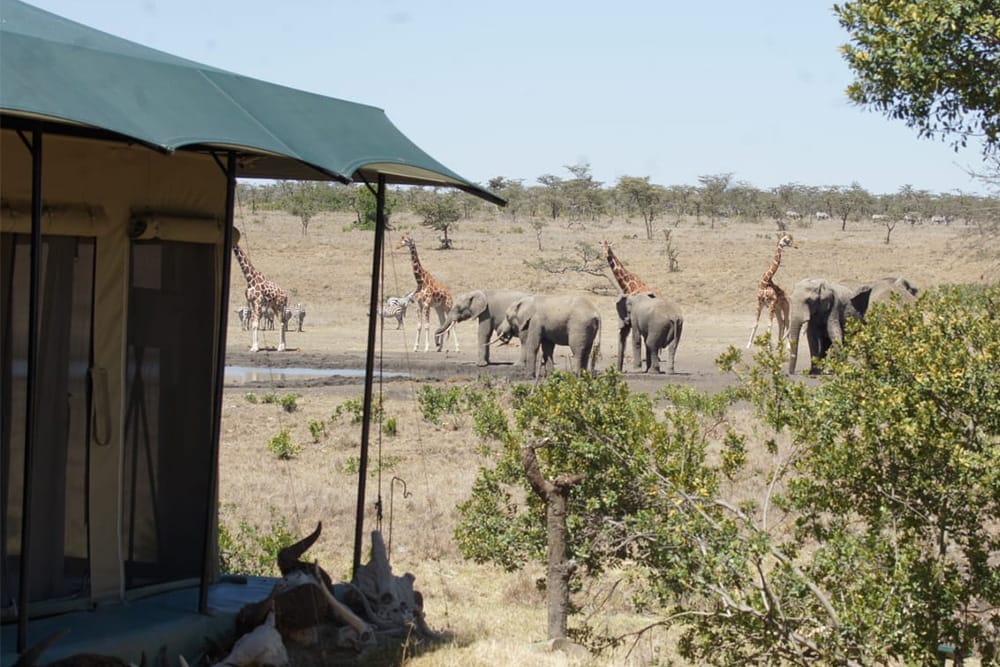
View of elephants, giraffes, and zebras from the Porini Rhino Camp lounge/mess tent (Photo by Edwin Mirara)

Lion Kills Baby Zebra in Porini Rhino Camp, Ol Pejeta Conservancy

Porini Rhino Camp, located in the Western part of Ol Pejeta Conservancy has been experiencing a lot of wildlife action lately with various wildlife flocking the tented camp. Guests at the camp have been seeing many elephants, giraffes, zebras, rhinoceros, birds and lions. There are even some rarely-seen animals such as stripped hyenas that have a den just behind one of the guest tents. Recently, our staff at camp got to witness one of the most exciting wildlife interactions, a female lion hunting down a baby zebra.

According to Porini Camps Relief Manager, Edwin Mirara, he was busy in his office at camp when he suddenly heard some loud galloping outside. He quickly went to check what was happening only to be met by a cloud of dust left behind by a herd of zebras and impalas on the run, being chased by a female lion. Excited that this was taking place within the camp, he rushed to get his camera, jumped into a safari Landcruiser together with one of the guides and followed the action.

Following a short chase that ended about 30 meters from one of the guest tents, the lioness, believed to be a member of the Ajali Pride, managed to catch one of the weakest in the group, a baby zebra. For smaller prey, lions use their paw to slap the rear of the animal on its legs or haunch to knock it off balance and then drag it down. A bite to the neck or throat quickly kills the animal. The lioness then carried its kill away from the camp, across the seasonal river adjacent to the camp, and into an open field about 100 meters away.

Lioness carrying its kill  (Photo by Edwin Mirara)

She was then joined by another lioness believed to be her sibling who joined her in devouring the fresh meal. Lions eat – a lot! Male lions will eat up to 7kgs in a day while females eat 4.5kgs. However, It is believed that both male and female lions are capable of eating up to 15% of their own body weight in just one feeding. They are also known to be very greedy and will hunt an animal even if they are not hungry. In fact, lions are so greedy that even when digging into this tiny zebra, they will not hesitate to hunt down any other animal that comes close to them. This being a small meal, the lionesses shared the meal grudgingly. 

In about 15 minutes and after a brief scuffle, the lionesses successfully succeeded in splitting the meal into two and after eating to their fill, one of them carried its remaining share to what is believed to be its cubs. Unfortunately, our team did not manage to see where the cubs were hidden. However, the two females are known to have seven cubs between them. In most cases when a pride is feeding, the smallest and weakest lions often lose out altogether when even hungry mothers will not share the kill with their own offspring.

One lioness taking remaining kill to cubs (Photo by Edwin Mirara)

The Ajali Pride has been around Porini Rhino Camp for about three weeks now due to the large number of animals that visit the waterhole that is right in front of the camp. The lions also go to the waterhole at night to drink water.

Women Self-Help Group receives Solar-Powered Milk Coolant – Maasai Mara

Community

Women Self-Help Group receives Solar-Powered Milk Coolant – Maasai Mara

A Maasai women group from the Greater Maasai Mara region in the former Ol Kinyei Group Ranch has benefit from a 3,000-litre solar-powered milk coolant donated by the World Wide Foundation for Nature(WWF) with funding from the German government in partnership with Gamewatchers Safaris and Porini Camps.

Dubbed “Ol Kiwu Self-help group” the 18-member group received the milk coolant as a result of leasing their land out for wildlife habitat conservation and tourism. Land which today constitutes the 18,700-acre Ol Kinyei Conservancy. 15 out of the 18 group members are Ol Kinyei landowners.

The coolant, officially launched on 30th April 2022 at Endonyo Narasha, is aimed at providing an alternative income to the Maasai women who will sell their product to commercial milk suppliers at a better price thus improving their livelihood. The Maasai’s life is largely centered on cattle herding and this project will enable them to increase the income they receive from the same cattle.

WWF has installed a total of 56 solar panels to power the milk coolant. Speaking during the launch of the project, WWF Kenya, Sub-landscape Coordinator, Samson Lenjirr said that the WWF is committed to improving the livelihoods of people who commit their land to wildlife habitat conservation.

“This is a purely 100% funding from WWF Germany and what we call the BMZ II that is through the Federal Ministry of Corporation through WWF and majorly what this has done is to ensure improvement of livelihoods that touches more on the people directly but of course with an inclination in wildlife conservation,” said Mr. Lenjirr.

In addition, Gamewatchers Safaris and Porini Camps paid for the piping for water and provided a loan to the women group to enable them to pay rent and for a security personnel among other things before they start making a profit from the project. Gamewatchers Safaris and Porini Camps Managing Director, Dr. Mohanjeet Brar, says that the project is important as it helps landowners reap greater benefits from setting their land aside for wildlife conservation.

“This is an area where there is no other milk cooling plant so what happens is that during the time that the cows have produced plenty of milk, there is no market for it. So, often the milk gets wasted, and they are not able to access higher prices. However now with the milk cooling plant in place the women will be able to actually buy from the surrounding community members, so people will have access to sell their milk at all times and they can now sell in bulk to commercial companies like Brookside,”  says Dr. Brar.

Kenya’s largest milk processor, Brookside Dairy Limited has already visited and shown interest in purchasing milk from the cooling plant. 

Ol Kiwu Self-help group Chair lady, Kileku Ene Sholo, who is also a landowner expressed her gratitude to the WWF and Gamewatchers Safaris and Porini Camps for the project saying that she now sees the importance of wildlife conservation.

This is something amazing because today we are with donors who have brought a project great as this. We thank you very much because you have brought us something very important. Something that most people would only dream of having. And now whenever I see this milk coolant, I will be thanking the wild animals,” said Shololo.

Over the years, Gamewatchers Safaris and Porini Camps have participated in various projects to provide benefits and amenities for communities that live outside the conservancies including providing bursaries and scholarships, digital learning, set up of predator-proof bomas and deterrent lights, toilet construction, beekeeping and more.  Learn more about our community outreach projects and how you can be part of it here: https://www.porini.com/about-us/supporting-communities/

WWF Kenya and Gamewatchers Safaris have been working closely with local communities and stakeholders in mitigating against human-wildlife conflict, habitat management, and securing existing rangelands while at the same time improving livelihoods.

Exploring Africa’s Wilderness on foot – Mara Walking Safaris

Travel Guide

Exploring Africa’s Wilderness on foot – Mara Walking Safaris

Have you ever imagined taking a slow-paced adventurous tour inside Africa’s wilderness on foot? Walking safaris are exactly that. Also known as bushwalks, walking safaris are completely different from game drives as they awaken all your senses allowing you to notice smells, sounds, and even colors of the wilderness.

Walking is prohibited in most of Kenya’s National Parks and reserves, however, in conservancies, it is an exciting option. One of the activities that we offer guests at Porini Camps is guided walking safaris. To ensure their safety, we ensure guests are accompanied by experienced and professional Maasai safari guides and armed rangers. 

Exploring the bush on foot brings you really close to nature as you learn about vegetation and animal behavior in detail.

“You get to learn about the trees, their traditional uses by the community, you get to see and sometimes even try wild berries, you get to see wild carrots, those that you can use as food, and you also could get to learn about some medicinal plants as well as animal footprints, animal “poo”, you will be able to understand more through the little things that you don’t usually get to see when you are on a drive,” says Jimmy Lemara, a professional guide, and manager at Porini Mara Camp.

Before embarking on the walk, all participants are briefed on the dos and don’ts of the adventure. First, when walking through the bushes, all guests are required to walk in a single file. Second, while walking on the open plains, guests are encouraged to walk together as a group. This ensures the animals remain at ease. Thirdly, guests are required to be as attentive as possible and listen to their guide throughout the walk.

During a stay at Porini Mara Camp, I had an opportunity to join Jimmy Lemara, a professional guide and manager at the camp together with two other guests who wanted to experience the magic of the bush on a walk. We left the camp at around 4.30 pm when the sun was not too hot carrying our Porini branded metallic water bottles. 

A few metres from the camp we came across the skull of an elephant. Jimmy and the other Maasai guides examined the skull and established it belonged to an old female elephant.

“This was a female and it had the second last set of teeth, so this was the last set coming out. Do you see this? The teeth are broken at this point. So this set is almost finished and the other set is pushing from the back here. Elephants get six sets of teeth and at the end of this one, there will be no more, an elephant dies of starvation because they cannot chew so they can’t eat,” Jimmy explains while pointing to its teeth with his rungu (Swahili word for a wooden club popular among Maasai’s as an emblem of warrior status).   

Jimmy further explains that the elephant died of stomach complications as reported by the veterinary. 

Next, we come across the Orange-Leaf Croton (Croton dichotomous), a tree with a natural insect repellent that is used by the local Maasai people to sweep their houses to keep flies away. Cats such as lions, leopards, and cheetahs also take shade under this tree to avoid insect bites and fly disturbance. It is the fly season in the Mara, so Jimmy tells us we can pluck some branches with leaflets and rub them on our clothes and skin to keep the flies at bay. Surprisingly, it does work.

As we continue walking, we spot another interesting-looking acacia tree. The tree has straight spines and large bulbous bases. Jimmy says it is called the Whistling Thorn (Vachellia drepanolobium).

“It is called a Whistling thorn because ants make holes in the bulbous bases and then when the wind blows, it makes a whistling sound as it blows through the holes. If you look at it a little closer, there are holes that ants use to go into the plant. Oh! Look… I just touched it and the ants are coming out. So they have a relationship with the plant. The plant provides them with food and they in return, protect the plant from the browsers. So, if a giraffe tries to browse on the soft parts of the plant, then all these ants will come out and get to the tongue,” says Jimmy.

When we reached the base of the hill, we came across a Greater honeyguide (Scientific name Indicator indicator). The Maasai warriors whistled to communicate with the bird which then made a distinctive call it led us to a tree that had a wild African bee honeycomb. Historically, the bird relies on man or on honey badgers to get wild honey out of a hole in a tree. In a very random and unique experience, we watched the warriors cover themselves with their Maasai shukas to protect themselves from the sting of the bees, light a fire right next to a tree to smoke the bees out, and harvest the honey right in the middle of nowhere. They made sure they left some for the honeyguide. Watch the video of the wild honey harvesting experience here: https://youtu.be/NIe0nU-5D34

We reached the top of the hill at sunset, around 6 pm, where we enjoyed a peaceful sundowner with a magnificent view of the conservancy as we enjoyed the taste of freshly harvested wild honey.  

Watch: Ol Kinyei Conservancy Walking Safari With Jimmy Lemara – Maasai Mara 

Jackson Liaram, a Porini Guide says that you can also expect to see medicinal plants used by local people for medicine, perfume, or decorations while on a bushwalk including Elephant pudding (Cissus rotundifolia), a succulent used to treat eye allergies and infection; Sandpaper bush(Cordia ovalis), an evergreen bush with rough leaves used to smoothen walking sticks and fingernails and Elephant pepper tree (Warbugia ugandensis), a tree with quinine. The Maasai used its bark and roots in a concoction that is used to treat malaria.

Guided safari walks are part of the package at Porini Camps. So next time you visit one of our camps, make sure you request a guided walk with Porini Maasai warriors for a chance to get engrossed in the wilderness and track the footprints of the big cats and their prey.