






Conservation
World Heritage Day: 5 Heritage Sites to Visit in Kenya
Every year on World Heritage Day, we are reminded that heritage is not just about the past ,it’s about identity, continuity, and the stories that shape who we are today.
In 2026, the focus on emergency preparedness highlights a growing reality: cultural sites are increasingly vulnerable to climate change, urban expansion, and human impact. Visiting these places is not only an opportunity to learn ,it’s also a chance to support their preservation.
If you’re planning time in Kenya, here are five heritage sites that offer a deeper connection to the country’s cultural and historical landscape:
Nairobi National Museum: Where Human History Begins
If Kenya is the “cradle of humankind,” this museum is its keeper.
The Nairobi National Museum doesn’t just display artifacts,it narrates evolution itself. Walk through the Great Hall of Mammals and you’ll encounter not only Kenya’s famous wildlife in stunning dioramas, but the famous Turkana Boy skeleton, one of the most complete early human specimens ever discovered.
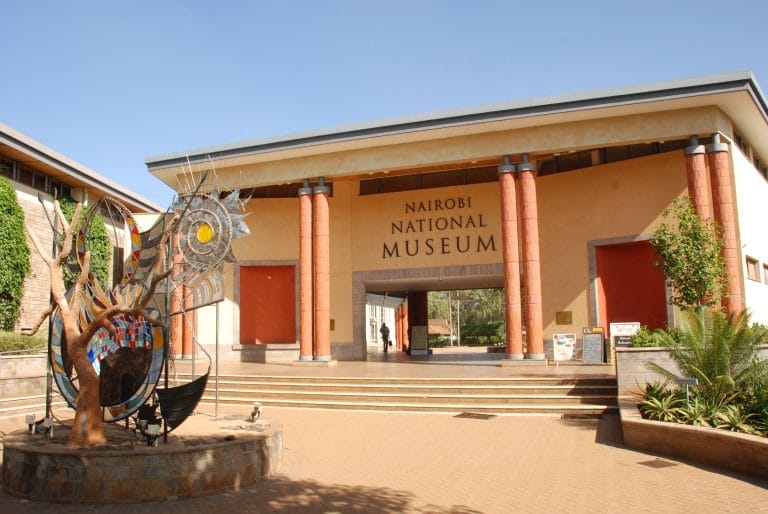
What makes this museum essential? It refuses to separate nature from culture. Traditional Maasai beadwork hangs near contemporary Nairobi paintings. Fossil fragments share space with colonial-era photographs. The result is a rare holistic portrait of a nation still writing its story.
Pro tip: Don’t skip the Snake Park next door,it’s a surprisingly engaging introduction to Kenya’s less charismatic (but equally fascinating) wildlife.
A strong starting point for understanding Kenya, this museum brings together history, culture, art, and natural science under one roof. From fossil discoveries to contemporary exhibitions, it provides a well-rounded perspective on the country’s evolution—past and present.
African Heritage House: Mud, Memory, and Masterpieces
Overlooking Nairobi National Park and rising from the savanna like a vision from West Africa, the African Heritage House stops you cold. Its hand-sculpted mud walls and geometric patterns seem impossible, too intricate, too bold, too alive for a building.

American architect Alan Donovan spent 50 years amassing the 6,000-piece collection within: Kente cloths from Ghana, Kuba textiles from Congo, masks that once danced at ceremonies now silent. But the house itself is perhaps his greatest acquisition,proof that African aesthetics can shape space as powerfully as canvas or clay.
This isn’t a typical museum. Visits are by appointment. You’ll likely meet Donovan himself, still advocating for African art to be recognized among the world’s great traditions. Come prepared for a conversation, not just a tour.
Fort Jesus: Stone Witness to Centuries of Struggle
Mombasa’s harbor has attracted traders for millennia. Fort Jesus stands as a warning and testament to what they fought over.
Built by the Portuguese in 1593, this star-shaped fortress was designed by an Italian architect to dominate the Indian Ocean trade routes. It failed. After a 33-month siege, Omani forces captured it in 1698, adding their own architectural layers mosques, Arabic inscriptions, slave market infrastructure.
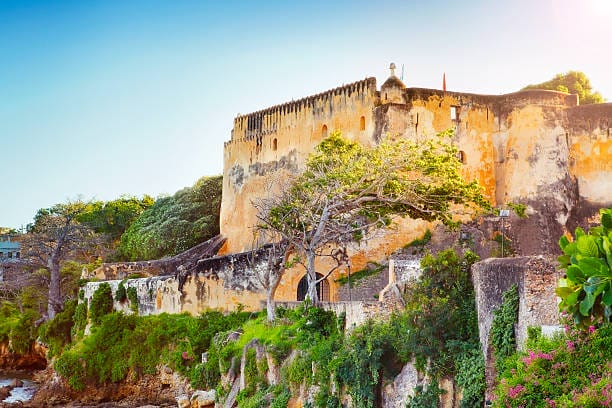
The British turned it into a prison. Today it’s a UNESCO World Heritage Site, its walls scarred by cannon fire and carved with graffiti from Portuguese, Arab, and British soldiers who stood watch over the same battlements, centuries apart.
The maritime museum inside displays ceramics pulled from shipwrecks ,Chinese porcelain, Persian glass, African pottery—all evidence of the cosmopolitan world that existed here long before colonial borders.
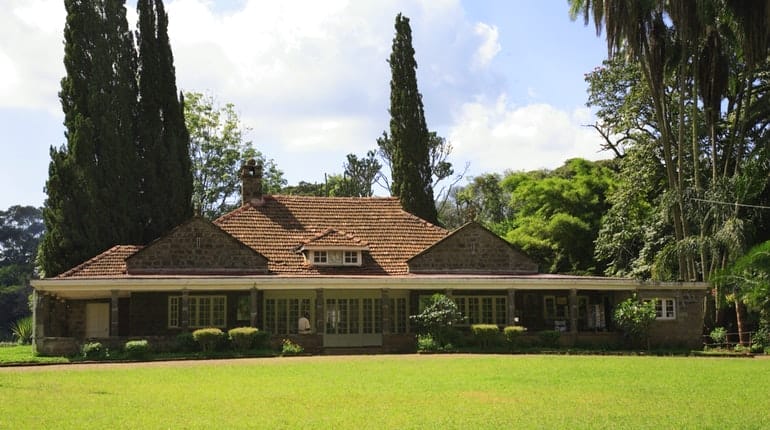
Karen Blixen Museum: Romance and Reality in the Highlands
The Ngong Hills roll green against the sky. On their slopes sits a modest bungalow that became legendary through the alchemy of words.
Danish author Karen Blixen farmed coffee here from 1917 to 1931, losing her fortune, her marriage, and her health—but gaining material for “Out of Africa”, her 1937 memoir that would define “colonial Kenya” for generations of readers. The 1985 film adaptation, with Meryl Streep against these same hills, cemented the myth.

The Karen Blixen Museum preserves Blixen’s writing desk, her cuckoo clock, the coffee-drying machinery that never quite paid for itself. But visit critically. Blixen’s affection for her African employees was genuine; her paternalism was equally real. The house offers insight into both the literary imagination and the unequal power structures that enabled it.
The suburb of Karen, now one of Nairobi’s most affluent areas, still carries her name—a complicated legacy in a post-colonial nation.
Set at the foot of the Ngong Hills, this former home of author Karen Blixen offers a glimpse into colonial-era Kenya and literary history.
Gedi Ruins: The Ghost Town in the Forest
No roads led to Gedi for 300 years.
Hidden within the Arabuko Sokoke Forest, this coral-stone city thrived from the 12th to 17th centuries, trading across the Indian Ocean with merchants from Arabia, Persia, India, and China. Then, around 1630, its inhabitants vanished. Not conquered. Not destroyed. Simply… gone.
Archaeologists still debate why. Water depletion? Shifting trade routes? Invasion by southern peoples? The forest reclaimed the stone houses, mosques, and palace, preserving them in tropical silence until British settlers stumbled upon the site in the 1920s.
Today, sykes monkeys peer from windows where Swahili merchants once counted Chinese coins. Golden-rumped elephant shrews dart across coral-paved streets.
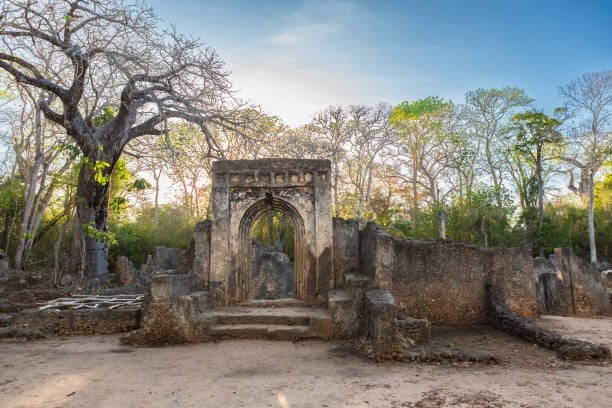
Walking the winding pathways at Gedi feels less like visiting ruins than discovering them—an experience of mystery rare in our over-mapped world.
The pillar tombs, the Great Mosque’s mihrab, the Palace’s octagonal courtyard—all suggest sophisticated urban life abruptly interrupted. Gedi doesn’t explain itself. That’s precisely its power.
Why Visiting Matters
These five sites trace Kenya’s story from prehistory through the Swahili golden age, colonial encounter, and cultural renaissance. Together, they offer something beyond typical safari tourism: understanding of how this land has been imagined, fought over, abandoned, and reclaimed across millennia.
Exploring these sites is not just about learning it’s about supporting their preservation. With increasing threats from climate change and human activity, strong response systems are essential to protect them.
Through conservation-focused travel, Gamewatchers Safaris helps visitors experience Kenya more meaningfully linking cultural heritage with responsible tourism and community support.
Have you visited any of these sites? Which Kenyan cultural experiences would you add to the list?
By Leocadia Odhiambo & Ivy Vuguza